Commercial Automatic Sliding Door Repair in Scottsdale AZ: Master Engineering Guidelines for Desert Climate Resilience and Code Compliance
Thermal Stress and Environmental Challenges for Commercial Automatic Doors in Scottsdale
Commercial automatic sliding doors in Scottsdale face extreme thermal degradation from solar radiation and ambient summer temperatures exceeding 115 degrees Fahrenheit. We find that intense radiant heat causes thermal expansion in aluminum headers and misaligns optical sensors, while airborne desert sand accelerates track wear. System failures require targeted mechanical adjustments and heat-rated component replacements.
In the Sonoran Desert environment, commercial entrances endure environmental pressures that do not exist in temperate regions. Direct solar exposure heats extruded aluminum door frames up to 160 degrees Fahrenheit, causing metal headers to expand and press against internal roller assemblies. This thermal expansion increases friction on carriage wheels, overburdening drive motors and triggering thermal overload switches. Additionally, fine quartz dust blown from surrounding desert terrain infiltrates the overhead header box and bottom guide tracks, creating an abrasive slurry when mixed with traditional grease.
- Thermal expansion of overhead aluminum headers leading to mechanical binding and motor strain.
- Degradation of standard rubber carriage rollers under constant exposure to high ambient heat.
- Optical sensor blind spots caused by intense solar glare and infrared wash out.
- Microprocessor control board overheating resulting in intermittent operational resets.
We recently resolved a severe real-world operational failure at a high-volume medical office building in North Scottsdale. The facility’s dual-panel automatic sliding entry doors repeatedly jammed during afternoon peak temperatures, leaving the doors locked in a halfway open position. Our diagnostic investigation revealed that extreme heat had warped the lower polymer roller tracks, while sun glare blinded the exterior active infrared presence sensors. We restored full operational reliability by retrofitting precision heavy-duty steel carriage rollers with high-temperature bearings, installing solar-shielded dual-technology motion sensors, and clearing track debris before applying a dry-film Teflon lubricant.
Diagnostics, AAADM Compliance, and ANSI/BHMA Standards
Proper diagnostic evaluation of commercial automatic sliding doors requires verifying mechanical track tolerances, electrical motor loads, and safety sensor calibration under current ANSI/BHMA A156.10 standards. We conduct structured inspections to isolate electronic circuit board faults, worn carriage rollers, and optical sensor blindness before minor mechanical resistance escalates into complete automatic door failure.
Adhering to professional standards established by the American Association of Automatic Door Manufacturers (AAADM) is essential for commercial facility safety. Every repair service must verify that detection zones, opening speeds, and safety reverse functions perform according to precise engineering tolerances. When system components drift out of calibration, automatic doors risk contacting pedestrians or failing during emergency evacuations. We follow a strict diagnostic procedure to restore peak performance across all sliding door components.
- Inspect overhead aluminum header tracks, drive belts, and carrier rollers for physical wear or thermal distortion.
- Verify electronic sensor activation thresholds, detection zone geometry, and safety beam crossover points.
- Measure motor electrical amperage draw and adjust microprocessor speed curves to prevent motor burnout.
- Test emergency breakout release mechanisms and power-failure battery fallback systems to ensure immediate manual operation.
To help commercial building owners evaluate operational risks, we have synthesized common sliding door failure modes alongside our proven field resolution protocols.
| Failure Mode | Primary Root Cause | Environmental & Climate Factor | Professional Field Solution |
|---|---|---|---|
| Door Panel Sticking or Dragging | Debris buildup and roller flat-spots | Fine quartz dust mixing with grease in summer heat | Flush tracks, install high-temp rollers, apply dry Teflon lubricant |
| Erratic Opening and Closing | Infrared sensor saturation and thermal drift | Direct Arizona sunlight washing out optical sensors | Recalibrate sensor thresholds, install optical hoods, upgrade to radar |
| Complete System Lockout | Control board thermal overload trip | Sustained ambient temperatures above 115 degrees F | Replace damaged circuit board, adjust motor amp limits, improve venting |
| Sudden Track Derailment | Continuous binding against expanded headers | Header frame expansion from direct solar exposure | Re-align header tolerances, replace worn guide shoes, reset panel balance |
ADA Title III Accessibility and Building Code Integration in Scottsdale
Commercial automatic sliding doors must satisfy federal ADA Title III standards and local Scottsdale building codes by guaranteeing a minimum 32-inch clear opening width and reliable emergency egress breakout function. We ensure that sensor timing, closing force limits, and panic release mechanisms operate seamlessly to maintain continuous legal accessibility and safety compliance.
Maintaining full compliance with federal accessibility guidelines set forth by the U.S. Access Board ADA Standards requires precise physical adjustments to automatic door operators. Commercial sliding doors in public facilities must provide smooth, barrier-free passage without requiring excessive force or rapid closing motions that could injure individuals with disabilities. Furthermore, activation devices such as push-plates or touchless wave sensors must be installed between 34 and 48 inches above the finished floor level. We verify that every automatic door installation maintains these strict clearance and timing parameters.
In commercial environments, selecting between full-power automatic sliding operators and low-energy swing operators involves distinct operational trade-offs. Full-power sliding doors compliant with ANSI/BHMA A156.10 offer superior traffic throughput, bi-directional pedestrian flow, and seamless hands-free operation for high-traffic retail or medical centers. Conversely, low-energy swing operators compliant with ANSI/BHMA A156.19 cost less to install but restrict traffic speed and require physical activation push-plates. We work directly with facility managers to select and calibrate the exact door architecture that matches building traffic volume and code mandates.
Repair Versus Replacement Decision Framework for Facility Managers
Determining whether to repair or replace a commercial automatic sliding door depends on operator age, control board architecture, component availability, and structural frame integrity. We advise replacing full operator assemblies when units exceed ten years of service with obsolete electronics, whereas targeted component repairs remain optimal for localized roller or sensor wear.
Property owners in Scottsdale must balance immediate capital outlay against long-term operational efficiency. Minor repairs, such as replacing worn carriage wheels or realigning infrared sensors, offer a cost-effective short-term remedy for newer door systems. However, repeatedly replacing legacy motors or obsolete analog logic boards on system headers over twelve years old leads to compounding repair bills and ongoing facility downtime. We provide clear financial and technical evaluations so building owners can make informed investment decisions.
- System Age: Operators older than ten to twelve years usually warrant full replacement due to component obsolescence.
- Operational Frequency: High-traffic entrances with over one thousand daily cycles benefit from modern, energy-efficient brushless motor upgrades.
- Frame Structural Condition: Severe frame sagging or header structural damage makes partial repairs ineffective.
- Compliance Upgrade Requirements: Older non-breakout systems requiring emergency egress modernization should be upgraded to modern breakout slider packages.
Replacing an outdated commercial automatic sliding door header package typically ranges from three thousand to six thousand US dollars depending on door width and glass configuration. In contrast, targeted repairs like roller replacements or sensor recalibrations generally cost between three hundred and eight hundred US dollars. We ensure full transparency in our evaluations, prioritizing long-term energy savings, improved thermal insulation, and minimal operational disruption for your Scottsdale enterprise.
Frequently Asked Questions
How often should commercial automatic sliding doors in Scottsdale undergo safety inspections?
Commercial automatic sliding doors should undergo professional safety inspections at least once annually by certified technicians, alongside daily visual checks by facility personnel. In high-traffic Scottsdale commercial environments, extreme desert heat and dust buildup degrade door components faster than average indoor applications. Annual inspections ensure strict adherence to ANSI/BHMA A156.10 standards and verify that emergency breakout mechanisms operate correctly. Regular servicing prevents unexpected operational downtime and protects property owners from potential legal liability.
Why do automatic door sensors fail during high-temperature Scottsdale summers?
Automatic door sensors fail during hot Scottsdale summers because direct sunlight creates infrared interference and extreme heat degrades sensitive internal optical electronics. Ambient air temperatures exceeding 115 degrees Fahrenheit cause thermal expansion inside sensor housings, leading to signal drift or complete sensor lockouts. We resolve this by recalibrating sensor sensitivity thresholds and installing heat-shielded cover hoods. Upgrading to dual-technology active infrared and radar sensors also eliminates sun glare blind spots.
What is the minimum clear opening width required for ADA compliance on commercial sliding doors?
The minimum clear opening width required for ADA compliance on commercial sliding doors is 32 inches when the door panel is fully opened. This measurement is taken between the face of the sliding panel and the opposite door stop or adjacent stationary jamb. Providing 32 inches ensures unhindered access for wheelchairs and mobility devices according to federal accessibility laws. We carefully adjust mechanical travel stops to maintain this required clearance during every repair service.
What causes commercial sliding doors to jump off their tracks or stick during operation?
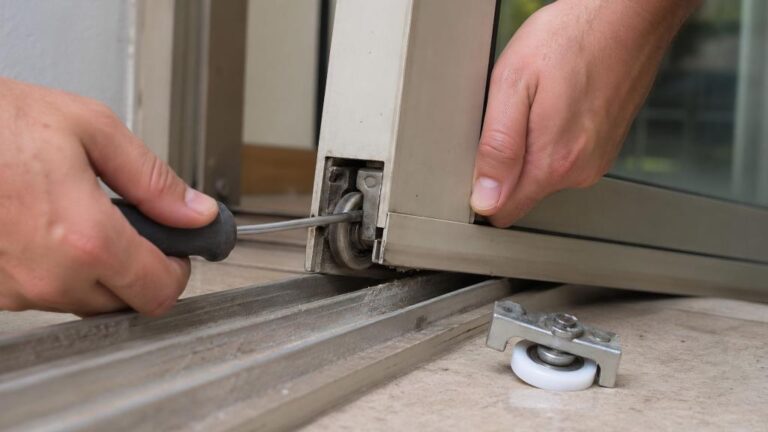
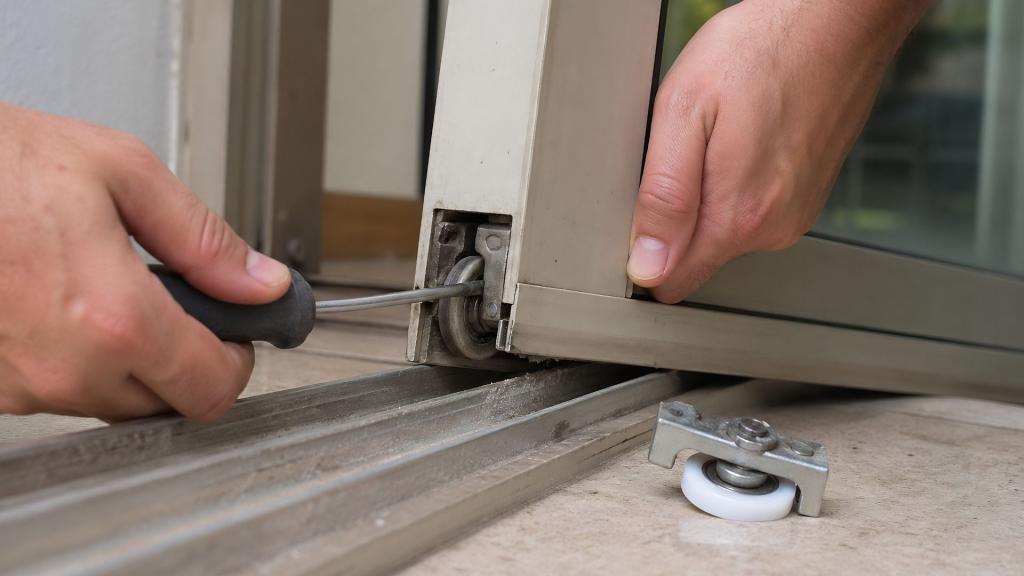
Commercial sliding doors jump off their tracks or stick primarily due to worn carriage roller bearings, debris accumulation inside the bottom guide channel, or track deformation. In Scottsdale commercial properties, fine quartz sand mixes with traditional lubricants to create an abrasive paste that damages wheel surfaces. Over time, flattened rollers cause the panel to tilt, drag along the floor track, or derail completely under motor pressure. We correct this by flushing contaminated channels, replacing damaged wheel assemblies, and applying non-stick Teflon lubricants.
Can emergency breakout systems be added to existing automatic sliding doors?
Emergency breakout systems cannot be added as a simple retrofit to non-breakout doors and require replacing the panel framing and pivot hardware assemblies. Full-power automatic sliding doors installed in egress paths must allow panels to swing outward manually during power outages or fire emergencies. Upgrading a non-breakout sliding door system involves retrofitting specialized breakout pivots, floor sweeps, and mechanical release latches engineered for ANSI compliance. We evaluate existing header structures to determine if frame modification or full package replacement is necessary.
Sources
- American Association of Automatic Door Manufacturers (AAADM): https://www.aaadm.com
- U.S. Access Board ADA Standards for Entrances, Doors, and Gates: https://www.access-board.gov
- Builders Hardware Manufacturers Association (BHMA) ANSI/BHMA A156.10 Standards: https://www.aaadm.com/ansi-bhma-standards/